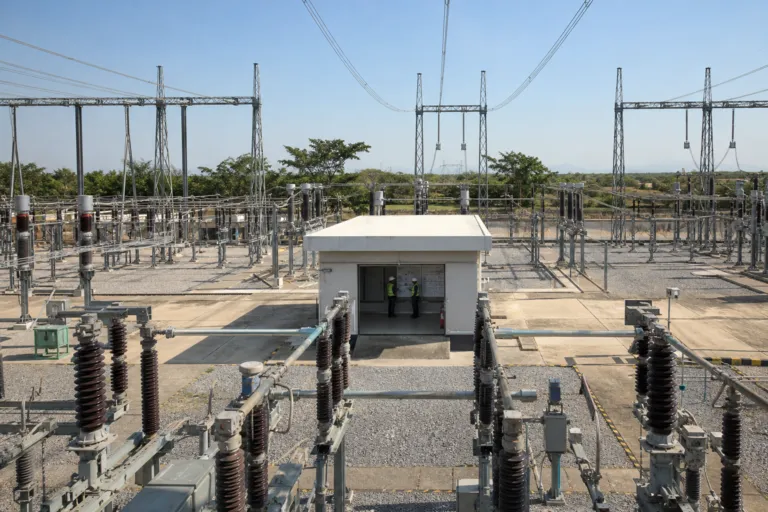
The ASEAN Power Grid (APG) has been on the regional agenda for decades, with the concept dating back to 1999. ASEAN has framed it as a way to lower energy costs, strengthen energy security, and integrate renewable energy across borders, but recent commentary stresses that financing alone will not turn “vision into voltage.” Today, progress is visible but uneven. One assessment notes about 7.7 GW of interconnection capacity across nine of ASEAN’s 18 priority projects, while also warning these links are still concentrated in the Greater Mekong subregion, where contiguous grids and surplus hydropower reduce integration costs. The result is deeper subregional connectivity, not yet a region-wide market.
A key proof point is the Laos–Thailand–Malaysia–Singapore Power Integration Project, which has been operational since 2022. It demonstrates technical feasibility for cross-border power trade, including Singapore importing renewable energy from Laos via Thailand and Malaysia. But multiple sources emphasize that it remains a controlled pilot rather than a competitive, open electricity market. It runs on fixed-volume contracts and leans on existing infrastructure, without yet solving harder operational issues such as congestion management, balancing supply and demand, or real-time payment settlement across different jurisdictions. In practice, that means the pilot validates interconnection, but it does not yet define a scalable template for a fully functioning regional power market.
From Bilateral Links to Shared Rules and Shared Trust
Momentum is also coming from outside the energy sector. One regional analysis argues that surging demand from AI data centers is testing ASEAN’s ability to execute the grid, and that “institutional reliability has become part of comparative advantage.” That framing puts the spotlight on common regulatory standards, grid codes, and the practical ability to guarantee cross-border energy flows. The same view expects early phases to continue as bilateral projects before any true multilateral market emerges. That progression matches the broader critique: without clear rules and credible institutions, the APG can remain a set of transactions rather than a cohesive, regional asset.
Indonesia illustrates both the scale of ambition and the difficulty of delivery. Commentary notes a government commitment of up to USD 38 billion to strengthen Indonesia’s national transmission network as a backbone for wider interconnection, including building 48,000 circuit kilometers of transmission lines over the next decade under the Electricity Supply Business Plan. Indonesia also imports around 200 MW of electricity from Malaysia to supply parts of Kalimantan that are not yet connected to the national grid, showing that cross-border electricity already plays a practical role. At the same time, Indonesia’s archipelagic geography makes inter-island and cross-border links dependent on subsea cables and high-voltage infrastructure that are expensive and technically complex, while PLN’s control over both transmission and generation can restrict private investment.
Across the region, financing constraints and governance needs keep surfacing together. A data compilation cites electricity demand growth of 3–4% annually in the region and highlights an investment mismatch: the World Economic Forum is quoted saying ASEAN needs at least USD 200 billion in annual energy investment by 2030, while current levels are around USD 8 billion. It also describes a SEA-6 CAPEX deployment gap of about USD 225 billion for 2026–2030, with roughly USD 540 billion announced but only about USD 315 billion expected to be deployed under current market conditions, including an estimated shortfall of about USD 210 billion in power and grid infrastructure. Ember’s subsea cable analysis adds that moving projects from ambition to implementation requires stronger planning, cost-allocation frameworks, and maritime coordination. Together, these are the make-or-break ingredients for ASEAN power grid interconnection to scale beyond pilots into durable cross-border reality.
How much interconnection capacity has ASEAN built so far under priority APG projects?
What does the Laos–Thailand–Malaysia–Singapore project prove, and what does it not yet solve?
What is Indonesia doing to support regional interconnection, and what are the constraints?
Why do institutions and standards matter for ASEAN’s cross-border grid?
What are the key investment gaps that could slow ASEAN power grid interconnection?