
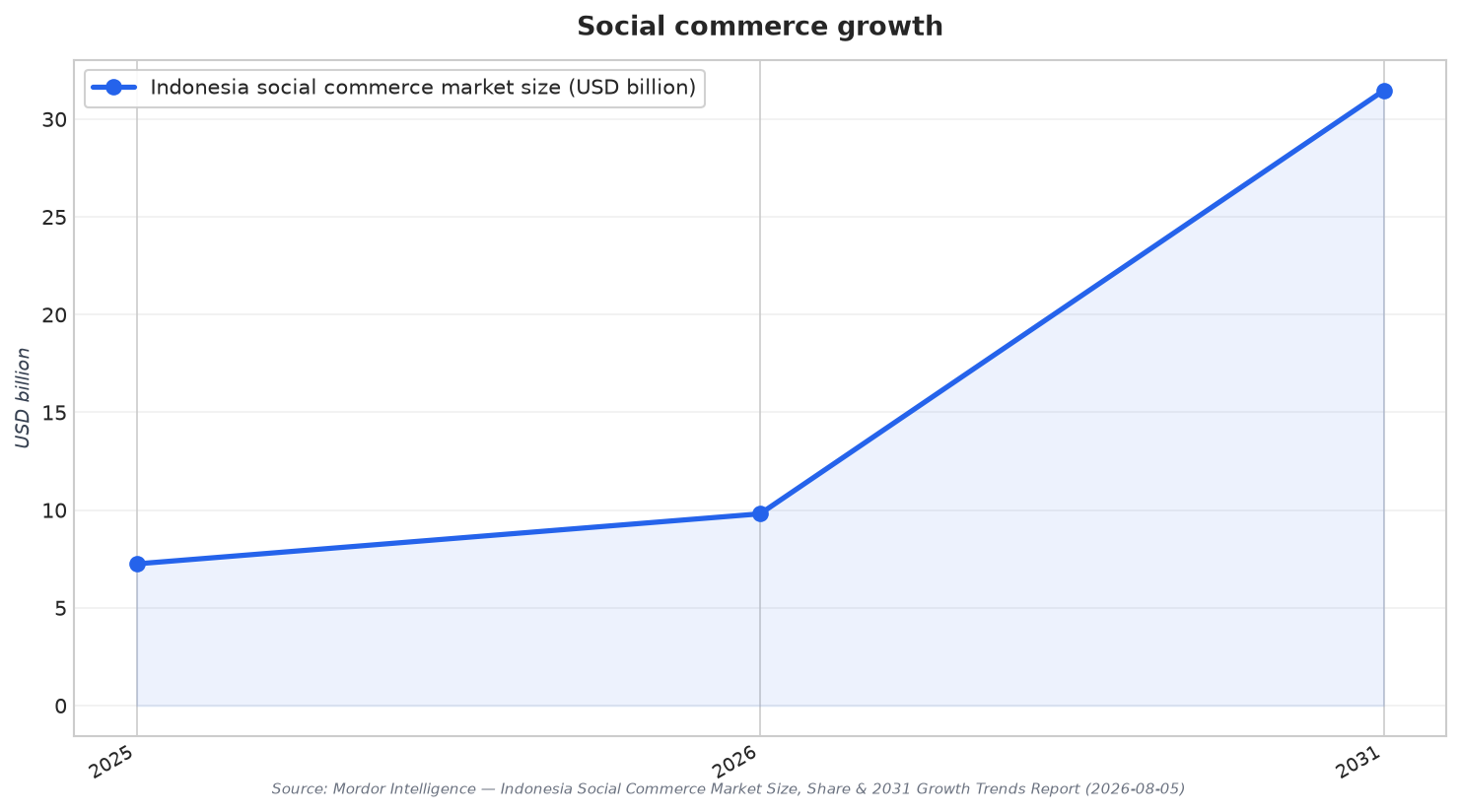
Jakarta’s push to tighten oversight of social-led selling is landing in a market that is still growing rapidly. Indonesia’s social commerce market was valued at USD 7.25 billion in 2025 and is estimated to rise from USD 9.81 billion in 2026 to USD 31.46 billion by 2031, according to Mordor Intelligence. That growth is being fueled by smartphone-first behavior and video-led discovery. Mordor also notes that regulatory separation between social media and transactional functions is one of the factors shaping how quickly the channel develops. In parallel, Indonesia’s broader e-commerce market is expected to grow from USD 90.35 billion in 2025 to USD 104.21 billion in 2026, with continued expansion projected through 2031.
The direction of travel on regulation is not new. Ken Research points to Indonesia’s Regulation of the Minister of Trade Number 31 of 2023, issued by the Ministry of Trade, which focuses on business licensing, advertising, guidance, and supervision of business actors in trading through electronic systems. In practice, that type of framework matters more as entertainment and commerce merge. Mordor reports that in 2025, video commerce accounted for 37.18% of Indonesia’s social commerce market, and smartphones accounted for 81.52% of the market. In 2026, smartphones accounted for 84.31% of internet access among Indonesia’s 235 million internet users, reinforcing why enforcement and platform design choices can quickly affect large user bases.
Consolidation Raises the Stakes for Compliance and Logistics
Regulatory tightening is also arriving as online retail consolidates. Mordor’s e-commerce analysis notes that consolidation among leading platforms is reshaping price competition and fulfillment standards, and it highlights higher operating costs linked to data-localisation rules and Jakarta’s traffic restrictions. A separate ResearchAndMarkets summary similarly expects social commerce to remain a growth driver, but under stricter regulatory frameworks, with competition intensifying around logistics, creator-led commerce, and merchant financing. The same summary notes that in 2024, after regulatory approval, TikTok Shop resumed operations through a structured partnership with Tokopedia, anchoring its commerce activities in an Indonesian-registered ecosystem and a physical merchant base.
Creators and live selling explain why enforcement is so consequential. Mordor reports that Indonesia recorded 2.6 billion video commerce transactions in 2025, up 90% from the prior year, while active video-selling merchants rose 75% to 800,000. Low order values of USD 4.5 and USD 6 are cited as still able to drive substantial platform volume when repeat purchases and creator-led traffic occur at scale. In Mordor’s broader e-commerce report, 60% of online buyers already purchase through live sessions, and video commerce reached 20% of online GMV in 2025 from less than 5% in 2022. In that context, Jakarta Social Commerce Rules become a lever that can shape not just compliance, but also the format choices platforms emphasize.
The consolidation story extends beyond pure e-commerce into the wider retail mix. Mordor’s retail report estimates Indonesia’s retail market at USD 56.87 billion in 2025, with Greater Jakarta holding 34.35% of that market size. It also reports that cash still accounted for 38.36% of retail market size in 2025, even as e-wallets are projected to grow through 2031. Euromonitor adds that retail e-commerce recorded a 10% increase in value in 2025, within a retail environment that saw 5% value growth in 2025. Taken together, tighter oversight, platform consolidation, and payments and logistics execution are converging into a more structured social commerce era rather than a free-form one.
How fast is Indonesia’s social commerce market growing?
What shows the scale of video commerce in Indonesia?
How do Jakarta Social Commerce Rules connect to platform consolidation?
What changed for TikTok Shop’s operations in Indonesia?