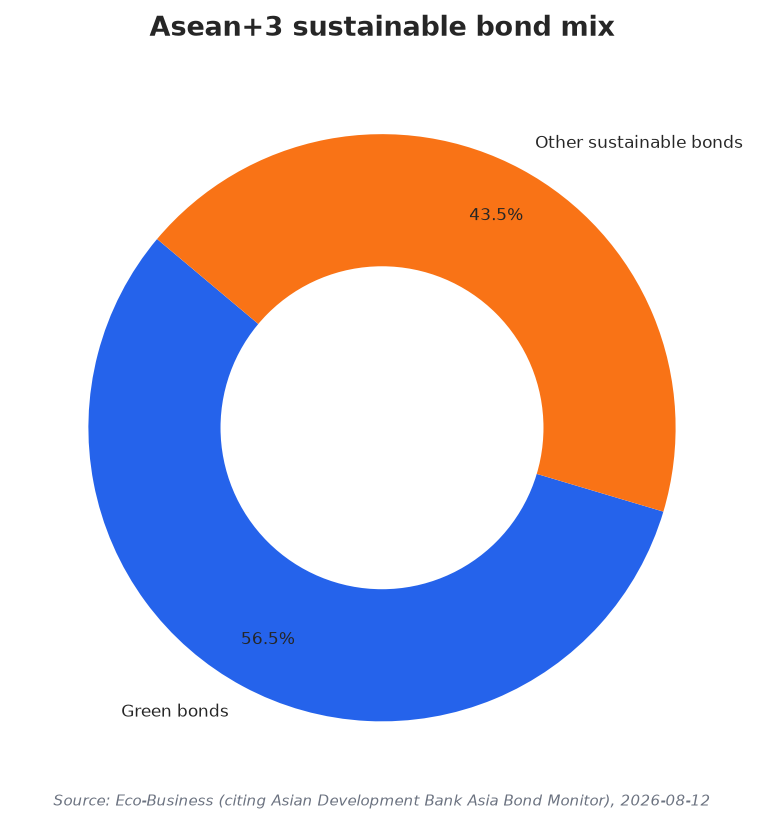
Green, social, and broader sustainability labels are changing how capital is raised and priced across ASEAN. In Asean+3 markets (the 10 Southeast Asian economies plus China, Japan, and South Korea), green bonds were still the largest segment at the end of March 2026. They accounted for 56.5% of sustainable bonds outstanding, worth US$576.9 billion, according to the Asian Development Bank (ADB). But that share was down from 61.6% two years earlier, a sign that the market is widening as more issuers add social, sustainability, sustainability-linked, and transition instruments alongside classic green bonds.
That widening matters for market depth. ADB data cited by Eco-Business puts the total Asean+3 sustainable bond market at US$1.02 trillion outstanding at the end of March, and says it is the world’s second-largest regional market after the European Union, representing 18% of global sustainable bond stock. New issuance weakened sharply in the first quarter of 2026, falling 31.1% quarter-on-quarter to US$46.9 billion, the lowest quarterly level in five years, as issuance in China declined. Yet excluding China, issuance rose to US$32.9 billion from US$29.6 billion in Q4 2025, an increase of about 11%.
Why ASEAN’s Policy and Issuance Mix Matters for Capital Markets
Within ASEAN itself, the use of sustainable bonds is relatively prominent in issuance mix. In the first quarter, such instruments made up 10.8% of total bond issuance in ASEAN, versus 4.5% globally and 11.6% in the European Union, according to ADB. The label mix is also supported by public-sector activity. Asia Asset Management reported ADB figures showing sustainable bond issuance in ASEAN of US$19.1 billion, accounting for 7.9% of the total including three North Asian markets, and noted ADB’s view that public-sector participation helps set long-term pricing benchmarks in domestic markets. It also cited that 80.6% of sustainable bonds sold in Southeast Asia were local currency debt, with an average size-weighted term of 14.7 years.
On-the-ground examples show how standards and deal types evolve into repeatable funding channels. Based on September 2022 ADB data cited by the Phnom Penh Post, Singapore had the largest amount outstanding among the ASEAN 5 at US$10.7 billion, comprised of domestic and regional issuances. The same source notes that Malaysia priced a US$800 million sustainability sukuk in April 2021, and that the Thailand Ministry of Finance became one of the first sovereigns globally to raise funds through sustainability bonds in August 2020, and the first in Southeast Asia. It also highlights corporate participation, including AC Energy and Infrastructure Corporation’s 2019 USD green bond debut totaling US$410 million, later increased to US$470 million, described as the first Climate Bonds Initiative-certified US dollar green bonds in Southeast Asia.
In 2026, regulatory and market signals are moving together, shaping expectations for the Southeast Asia green bond market. TEMBUSU Asia reports that on 4 August 2026 Thailand initiated Phase 2 of its national Green Taxonomy, expanding criteria into agriculture, construction and real estate, manufacturing, and waste management. Alongside this policy momentum, it cites a financial rebound: ESG loan volumes in Southeast Asia surged 54.1% quarter-on-quarter to US$9.4 billion in Q2 2026, while green bond issuance proceeds jumped 72.9% to US$7 billion from US$4 billion in Q1 2026. Taken with ADB’s evidence of diversification beyond green labels, these moves point to deeper capital markets where more issuer types, more instruments, and clearer definitions can support repeat issuance.
What share of Asean+3 sustainable bonds were green bonds in early 2026?
How large is the Asean+3 sustainable bond market, according to ADB?
What does recent issuance suggest about momentum in the Southeast Asia green bond market?
Which ASEAN country had the largest GSS amount outstanding among the ASEAN 5 in the cited ADB snapshot?