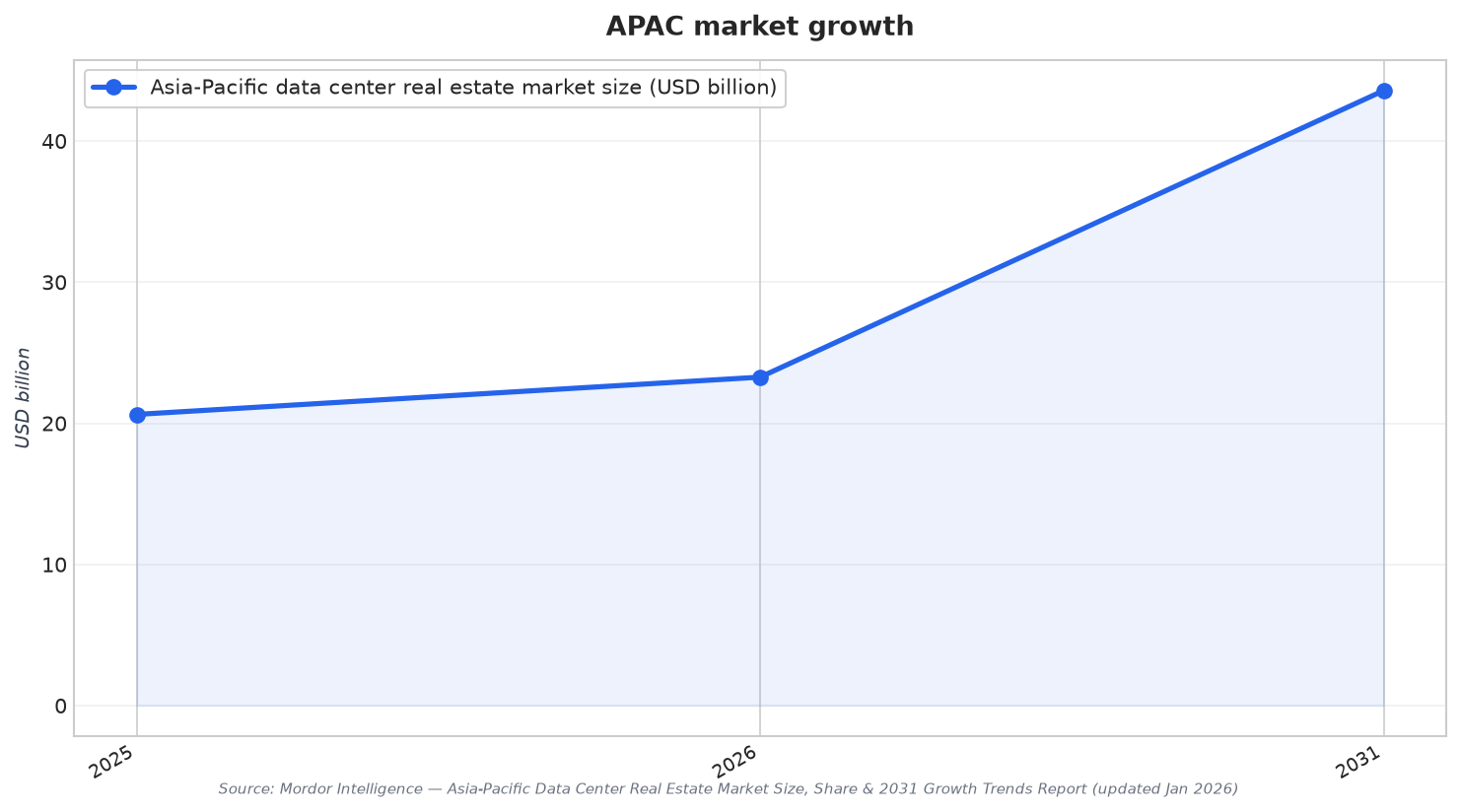
Data centers are increasingly treated like a mainstream property play in Southeast Asia, not just an IT project. Across the wider Asia-Pacific data center real estate market, Mordor Intelligence expects market size to rise from USD 20.63 billion in 2025 to USD 23.27 billion in 2026, and to reach USD 43.57 billion by 2031, with a 13.36% CAGR over 2026–2031. The same report links demand shifts to AI-led infrastructure needs, including GPU-heavy users and single-tenant AI buyers that reserve capacity before construction is finished. That pre-leasing behavior changes how developers underwrite projects and can pull forward land and power decisions.
In Southeast Asia specifically, demand signals are tied to AI, automation, and digitalization across industries. ResearchAndMarkets states that AI computing requirements are projected to increase nearly tenfold by 2030, and that regional data center capacity is expected to almost triple to support that wave. Governments also push the enabling digital stack. Thailand’s Thailand 4.0 framework promotes Smart City and Industry 4.0 projects, while DEPA collaborates with public and private partners to accelerate IoT deployment under the Ministry of Digital Economy and Society (MDES). These policy-driven projects add to the commercial pull from sectors adopting AI and machine learning, which keeps the pipeline active for both hyperscale and colocation developments.
Capital, Power Access, and New Growth Nodes Are Repricing the Map
Capital markets activity shows how much this asset class has matured. CBRE data cited by The Real Deal says data center investment in the APAC market reached a record USD 11.6 billion in 2025. It also notes that in 2025, company-level transactions involving platforms and data center operating companies in APAC totaled USD 8.3 billion, reflecting investor preference for liquidity and asset-specific exposure. Within Southeast Asia’s orbit, Johor in Malaysia stood out: CBRE reported it saw the biggest growth in live data center capacity across Asia-Pacific in 2025, rising 53% year over year, while Singapore and Hong Kong saw growth between 6% and 8%. CBRE also attributes the shift to rising construction costs, drawn-out delivery timelines, and power constraints in established markets, which is pushing built-to-suit deals, infrastructure partnerships, and local development alliances.
Sustainability and utilities are becoming decisive real estate variables, not side considerations. ResearchAndMarkets describes a growing emphasis on sustainable infrastructure and clean energy adoption, supported by government initiatives and corporate decarbonization goals. It also gives concrete examples. In October 2025, NeutraDC signed an electrical purchase agreement with Indonesian utility PT PLN Batam to supply 90MVA of medium-voltage electricity to its Batam data center between 2025 and 2028. In August 2025, DayOne announced plans to integrate alternative water sources in Johor, including Malaysia’s first river water treatment system designed for data center operations at its facility in Kempas Tech Park. These moves tie site selection to grid access, power contracts, and water strategy, which can elevate certain industrial corridors into premium digital infrastructure zones.
For investors thinking about Southeast Asia data center real estate, the product mix and tenant structure matter as much as the country story. Mordor Intelligence reports that colocation facilities held 45.80% of Asia-Pacific data center real estate market share in 2025, and leased properties accounted for 76.90% of market size in 2025. That matters because the sector’s cash-flow profile often depends on lease structures and pre-committed demand. Meanwhile, Market Data Forecast estimates the Asia Pacific data center colocation market will grow from USD 15.95 billion in 2024 to USD 64.03 billion in 2033. It also cites a 2024 Frost & Sullivan study indicating that over 40% of Fortune 500 firms operating in Southeast Asia shifted non-core applications to Tier 2 colocation sites, aiming to optimize expenses while maintaining operational continuity.
Why are data centers being treated as a major real estate asset class in Southeast Asia?
What figures show rising investment activity in Asia-Pacific data centers?
Which market saw standout capacity growth, and what was the rate?
How are sustainability and utilities shaping new data center sites in Southeast Asia?
How is colocation positioned in the regional real estate mix?