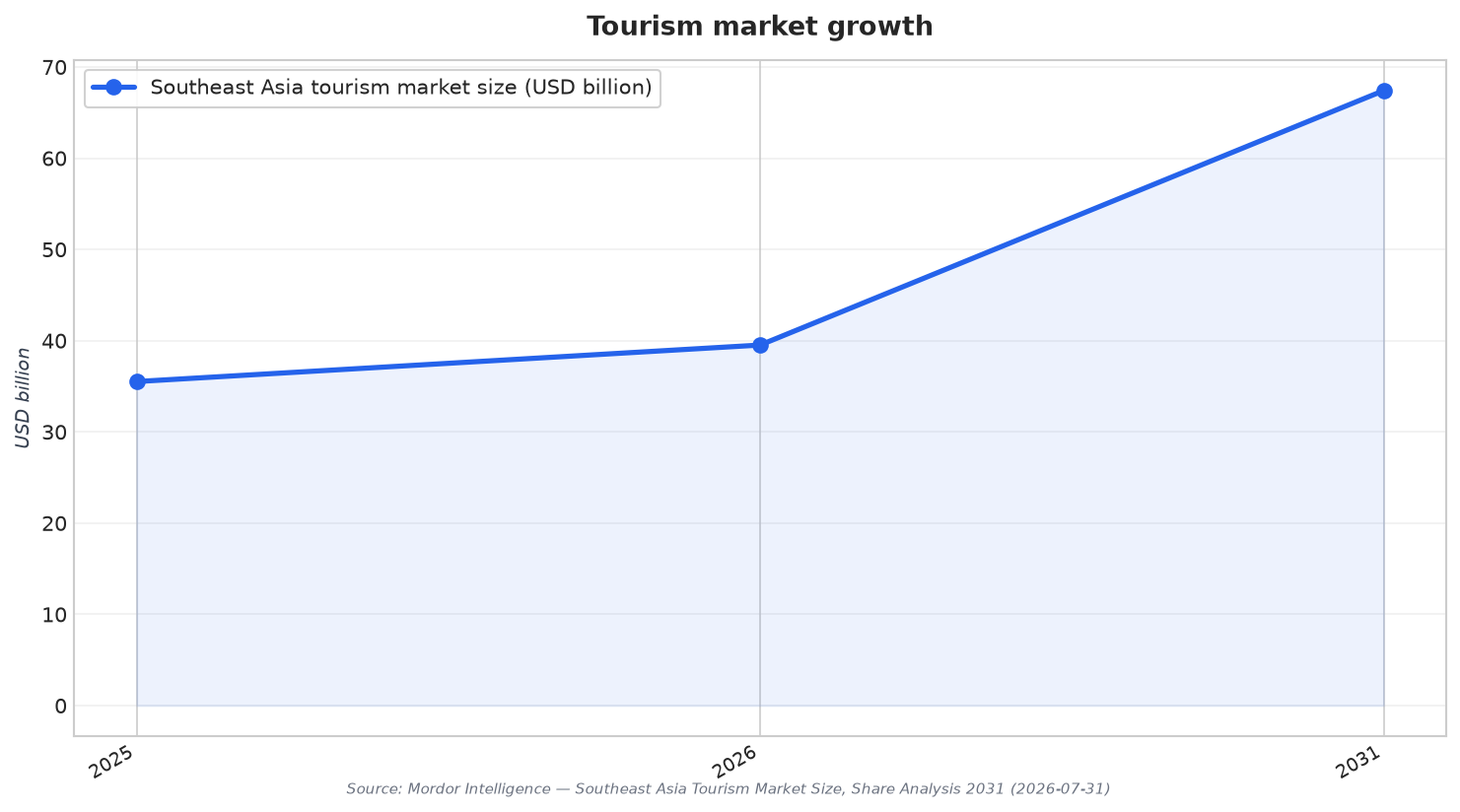
Southeast Asia’s long-stay tourism market is changing as governments adjust entry rules for remote workers and location-independent professionals. Mordor Intelligence forecasts the Southeast Asia tourism market to grow from USD 35.52 billion in 2025 to USD 39.52 billion in 2026, and to reach USD 67.41 billion by 2031 at an 11.27% CAGR over 2026–2031. In that same report, visa reforms are named as a key driver alongside low-cost carrier expansion and rising disposable incomes. For long-stay travelers, the visa piece matters because it removes friction and turns a short holiday into a longer, more routine stay that blends work and travel.
New visa categories are also arriving into a global market that is already scaling fast. DataIntelo values the global digital nomad tourism market at $89.7 billion in 2025 and projects $243.6 billion by 2034 at an 11.7% CAGR for 2026–2034. It also estimates that, as of 2026, about 35 million people identify as full-time digital nomads, while 72 million people do location-independent work at least part of the year. The same source says more than 60 countries had launched or proposed formal digital nomad or remote worker visas by early 2026. In Southeast Asia, this creates a direct pipeline from global remote-work adoption into longer stays, housing demand, and repeat travel patterns.
Visa Design Is Now a Competitive Tool in Long-Stay Tourism
Policy details show how countries are trying to capture more of the long-stay segment. Mordor Intelligence notes Thailand doubled visa-free stays to 60 days for 93 nationalities and introduced the Destination Thailand Visa that grants 180-day renewable residence to remote workers. These changes sit within a broader regional push toward smoother entry, including e-visa roll-outs and waivers. At the same time, the market mix is already shifting: accommodation services held 58.15% of the Southeast Asia tourism market size in 2025, while travel services are expected to expand at a 12.01% CAGR through 2031. Longer stays can amplify both, but especially the recurring service layer, including in-destination activities that Mordor says are capturing an increasing share of spending via mobile booking.
Southeast Asia’s position as a digital nomad hotspot is supported by multiple datasets, but the scope differs by source. MarketIntelo states Asia Pacific is the dominant regional market for digital nomad tourism, with 38.2% of global revenue in 2025 and a value of approximately $458 million. It adds that Southeast Asian destinations including Thailand, Vietnam, and Bali in Indonesia offer monthly living costs between $800 and $1,500 for comfortable mid-range accommodation, coworking access, and dining, compared to $3,000 to $5,000+ in North American and Western European cities. Separately, a 2026-updated digital nomad statistics roundup reports Southeast Asia was rated the most popular region with 34% of votes, and that 11% of nomads reported Thailand as their current location. Together, these signals help explain why the ASEAN digital nomad visa economy is becoming an explicit target for tourism strategies.
The long-stay shift also shows up in how the tourism market is segmented and where growth is expected. Mordor Intelligence reports domestic travel held 63.72% of the Southeast Asia tourism market share in 2025, while international arrivals are forecast to grow at an 11.05% CAGR through 2031. It also notes Thailand held 19.06% of the regional tourism market share in 2025, and Vietnam is projected to log the fastest 13.22% CAGR through 2031. Travel and Tour World adds that digital nomad visas are extending the traditional travel season and pushing travelers toward longer stays and secondary cities where high-speed internet and lower costs of living are key draws. The combined effect is a more competitive, policy-led race to win longer-stay demand.
How are digital nomad visas changing long-stay tourism in Southeast Asia?
What specific long-stay visa change did Thailand introduce for remote workers?
What is the outlook for Southeast Asia’s tourism market size through 2031?
How does the ASEAN digital nomad visa economy connect to global remote-work trends?
Which tourism segments are most important as long-stay demand grows?