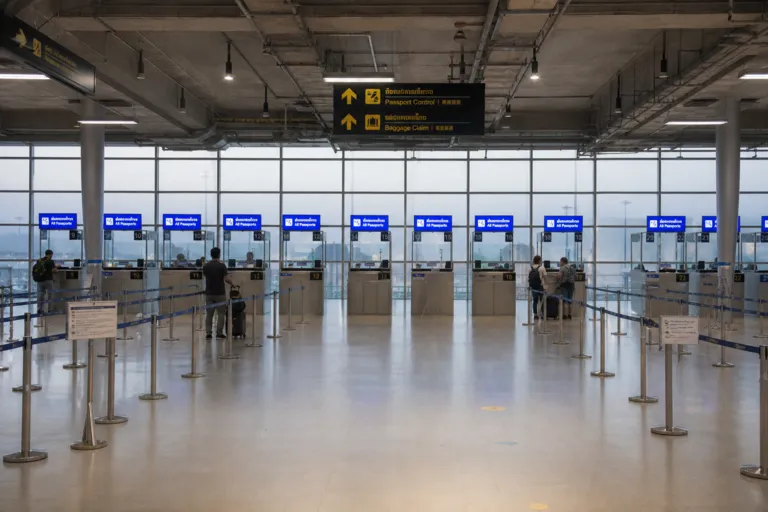
Visa rules are only one part of a recovery story. Thailand’s mutual visa-free arrangement with China took effect in March 2024, and industry analysis links this liberalization to a wider pool of independent travelers who are more likely to buy premium goods at airports. That tailwind matters for sectors like travel retail, where the Thailand Travel Retail Market was valued at USD 3.28 billion in 2025 and estimated at USD 3.62 billion in 2026, with a forecast to reach USD 5.84 billion by 2031. Yet the same analysis also notes that Chinese arrivals remained below pre-pandemic benchmarks in 2025, changing who spends and where demand concentrates.
The tourism numbers in 2026 show momentum, but also friction. Official figures cited for January 1 to September 26, 2026 put Thailand at 22,666,429 international arrivals and ฿1.105 trillion in revenue, despite temporary disruption from severe flooding in Bangkok that created road delays and temporary luggage processing backlogs at Suvarnabhumi Airport (BKK). That year-to-date performance was described as a minor 3.65% contraction compared to the same period in 2025. Thailand’s revised 2026 target cited in the same data was 33 million visitors, implying a need for about 10.33 million additional arrivals before December 31, or roughly 108,000 daily arrivals.
China Is Back on Top, but the Scale Has Not Fully Returned
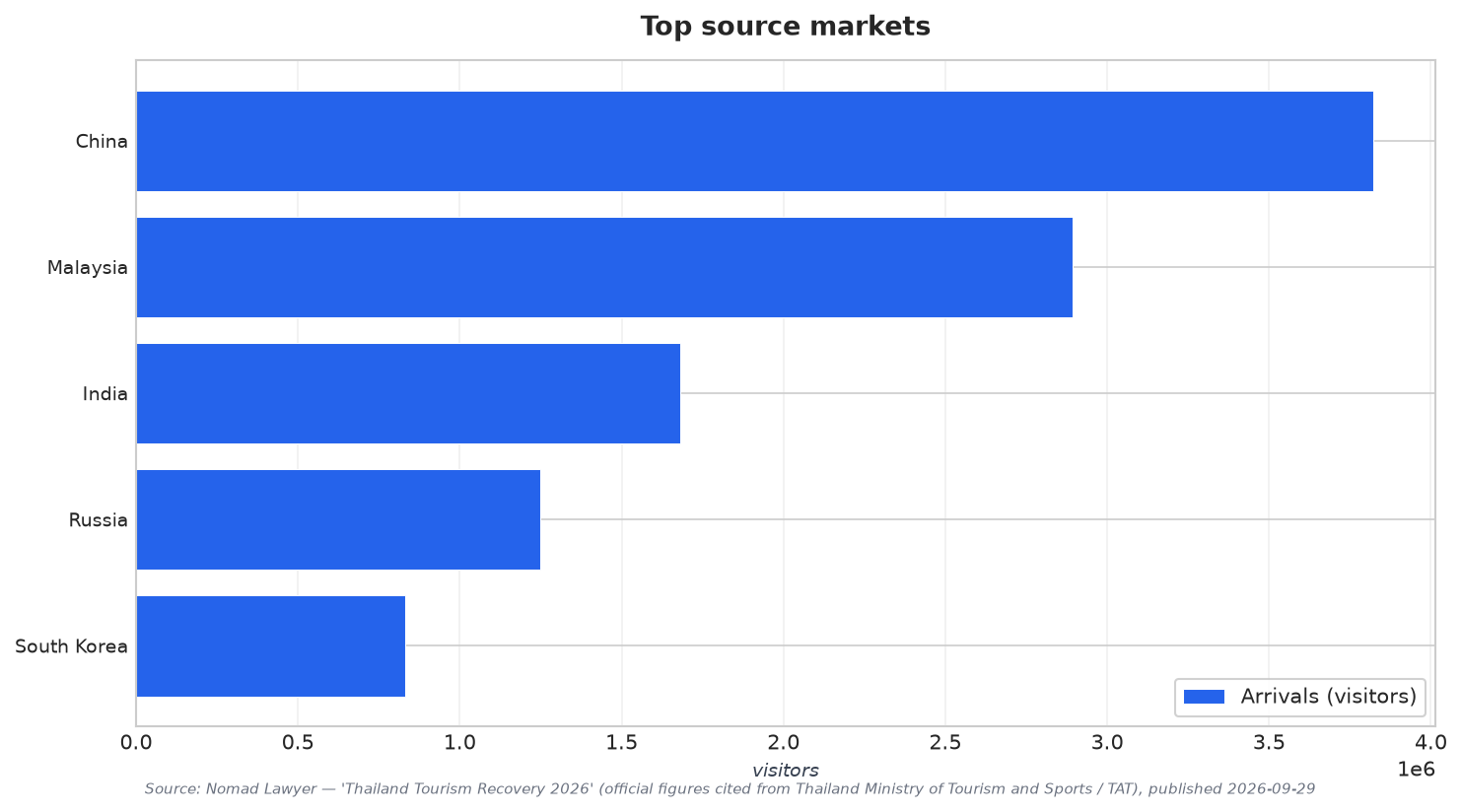
China’s return as Thailand’s largest source market is clear across multiple 2026 snapshots, but the rebound remains uneven. Through September 26, 2026, China led year-to-date arrivals with 3,822,928 visitors, ahead of Malaysia (2,891,908), India (1,680,725), Russia (1,249,801), and South Korea (831,716). Earlier in the year, ministry figures quoted for January 1 to July 4, 2026 showed 16,210,890 arrivals and ฿782.57 billion generated, with China leading at 2,654,728. Through August 22, 2026, another update put China at about 3.44 million visitors, while noting arrivals remained far below 2019 levels.
The unevenness is also visible when comparing recent years and expectations. Ministry figures cited elsewhere show Chinese visitors fell from around 6.73 million in 2024 to about 4.47 million in 2025, a drop of roughly 34%. That same reporting describes Thailand targeting 7 million Chinese visitors in 2026, while also noting operators had cut a forecast from 9 million to 7 million, citing safety concerns linked to scam networks and rising travel costs. In the broader totals, Thailand’s arrivals declined 7.23% to 32.97 million in 2025, described as its first annual fall outside the pandemic years, reinforcing why the pace of the China rebound still matters.
Spending patterns add another layer to the story. Travel retail analysis says the August 2024 closure of all inbound duty-free shops redirected spending toward departure-side stores and downtown formats, concentrating volume in core locations. In 2025, airports accounted for a 65.42% share of Thailand travel retail, while Cosmetics & Fragrances led product mix at 44.12%. With Chinese arrivals below pre-pandemic benchmarks in 2025, the same analysis says sales mix shifts toward long-haul and high-value cohorts, increasing pressure on operators to improve basket size through curated assortments and omnichannel pre-order. This is why Thailand Chinese Tourist Recovery can look strong in rankings but still feel uneven on the ground.
When did Thailand and China start mutual visa-free travel?
How many international arrivals and tourism revenue did Thailand record through late September 2026?
Is China Thailand’s top source market again in 2026?
What shows the Thailand Chinese Tourist Recovery is uneven rather than complete?
What travel retail shifts are tied to the tourism recovery mix in Thailand?