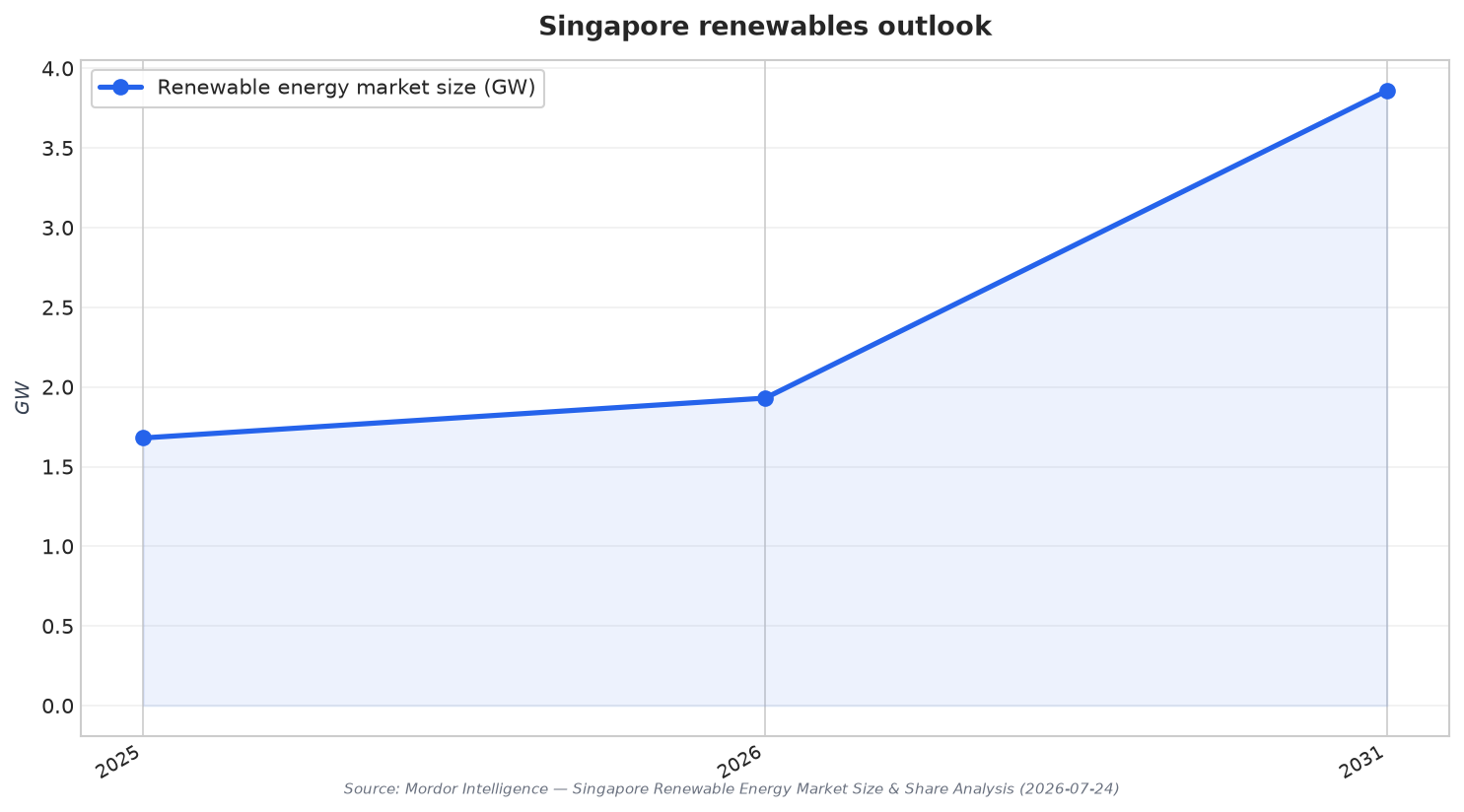
Singapore is building a cross-border clean electricity pathway because local constraints limit how far domestic renewables can go. In the Singapore renewable energy market, capacity is estimated at 1.93 GW in 2026, up from 1.68 GW in 2025, with a 2031 projection of 3.86 GW and a 14.86% CAGR over 2026–2031. Solar dominated with 83.65% market share in 2025, reflecting a preference for rooftop, floating, and near-shore deployments in a city-state with 728 sq km of land. This domestic ramp-up is paired with import ambitions, including a regional import target of 6 GW by 2035 that positions Singapore as a cross-border clean-power hub.
On the Indonesia side, an S&P Global note describes an agreement tied to seven projects in the Riau Islands and Sumatra with a combined capacity of 3.4 GW. That pipeline is framed as supporting Singapore’s ambition to import up to 6 GW of clean power by 2035, and the same source links this to an Energy Market Authority target that would make imports one-third of Singapore’s electricity mix by 2035. Another set of agreements broadens the map. Singapore has signed deals with Indonesia, Cambodia, and Vietnam to import about 5.6 GW of clean electricity by 2035, according to a report citing EMA chief executive Puah Kok Keong. These figures show how cross-border corridors are becoming integral to system planning.
What It Takes to Make the Corridor Bankable
Execution depends on cost clarity and regulatory certainty. S&P Global cites Energy estimates that the Singapore–Indonesia cross-border project could cost about S$300/MWh, reflecting grid charges and backup costs, and says this is about 17% above the prevailing retail electricity rate in Singapore. The same item adds that offtakers buying directly from the wholesale market are required to pay REC prices around S$130–140/MWh for developers to recoup costs. Regulation is also a gating issue. The report notes that electricity export licenses required in Indonesia for cross-border projects have yet to be issued, and that details such as wheeling fees and license terms were expected to be updated within the year, shaping timelines to financial close.
System design requirements can be very large once intermittency is accounted for. Puah estimated that supplying 2 GW of electricity from Indonesia to Singapore could require about 11 GWp of solar generation capacity and around 20 GW of battery storage. Singapore is also investing in its own flexibility and forecasting. One market analysis highlights Southeast Asia’s largest 285 MWh battery system and a solar forecasting model funded by SGD 6.2 million in R&D grants as examples of how grid operators are tackling intermittency. Even with rising imports, the same energy-box report says natural gas is still expected to account for at least 50% of Singapore’s electricity mix in 2035.
The corridor narrative also sits inside Singapore’s longer-horizon energy pathway. Ember reports that under the Singapore Green Plan 2030, solar generation is set to rise from less than 1 TWh in 2023 to 5.1 TWh in 2035, while renewable imports reach 26 TWh. Ember also states that electricity demand is set to reach 128 TWh by 2050, reinforcing the case for imports beyond domestic solar capabilities. On the market side, IMARC projects the Singapore energy market to grow at a 7.52% CAGR during 2026–2034, reaching USD 150.7 Million by 2034, and ties growth drivers to cross-border renewable power import activation and rising electricity demand segments. In this context, Singapore Indonesia Green Power Trade becomes both an infrastructure challenge and a commercialization pathway that depends on firm contracts, licensing progress, and workable total delivered costs.
What project capacity is linked to planned clean electricity exports from Indonesia to Singapore?
What are the key cost signals for Singapore–Indonesia cross-border clean electricity?
How large could solar and storage needs be to deliver 2 GW from Indonesia to Singapore?
How does Singapore’s Green Plan frame imports and domestic solar growth?
What does Singapore-Indonesia green power trade mean for Singapore’s 2035 electricity mix?