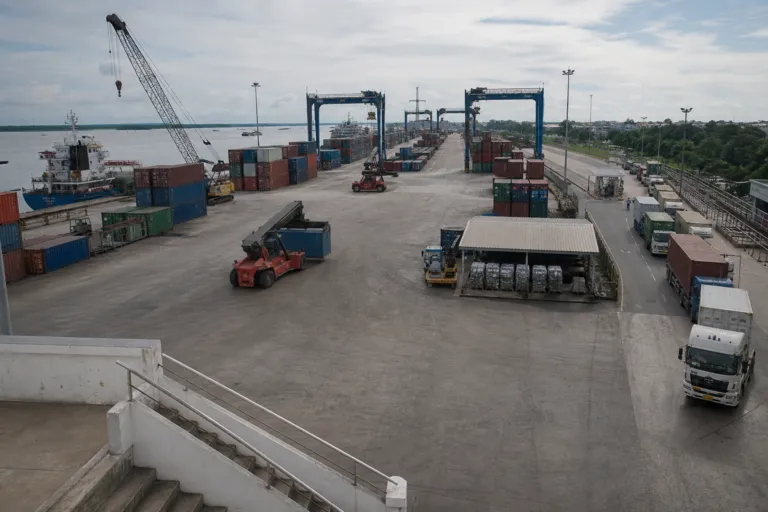
In 2026, supply reroutes are changing how Myanmar connects to neighbors and global buyers, even as trade continues to move. A World Bank transport and logistics monitoring report describes a system operating in “persistent disruption rather than recovery” since the February 2021 military takeover, with conflict, foreign exchange shortages, supply chain disruptions, and the March 2025 earthquake reshaping movement patterns. One central shift is rising dependence on Yangon’s seaports. The report says containerized exports through Yangon have risen to levels above those recorded before 2021, supported by demand for agricultural commodities such as rice, maize, beans, and pulses. At the same time, containerized imports remain significantly below pre-crisis levels because of foreign exchange constraints and restrictive import licensing requirements.
Border commerce still matters, but it is being forced to adjust. Thailand and Myanmar share approximately 2,400 kilometers of land border with key crossings including Mae Sot–Myawaddy, Tachileik–Mae Sai, and Ranong–Kawthaung. The Thailand–Myanmar border trade statistics report states that the Mae Sot–Myawaddy route accounts for more than half of bilateral border trade and acts as a main artery for consumer and industrial goods. Yet the same source highlights volatility at the checkpoint level. It notes that trade with Myanmar at one checkpoint in September 2025 was THB 9,401 million, and that figure represented a sharp year-on-year decline of about 40%, with disruptions such as bridge closures and regulatory tightening contributing to fluctuations. These stop-start conditions are a core driver behind Myanmar Border Trade Shifts in 2026, as firms keep searching for workable lanes.
Seaports, Barges, and Informal Channels Fill the Gaps
As land routes face disruption, maritime corridors are taking a larger role. The World Bank report links the move from land routes to maritime corridors to ongoing conflict along key borders with Thailand and China, which has disrupted traditional trade routes and pushed traders toward sea transport. It points to new services such as the Yangon–Ranong container barge connection as an alternative to land crossings. However, the same analysis cautions that large volumes of trade may continue moving through informal channels outside official reporting systems. This mix—formal seaport scaling, emerging water links, and partially unrecorded flows—helps explain why exports can keep flowing even when overland corridors become unpredictable.
Logistics market research also frames 2026 as a year of restructuring around compliance and corridor choices. One forecast values the Myanmar freight and logistics market at USD 6.35 billion in 2026 and projects growth at a 3.21% CAGR to USD 7.43 billion by 2031, while noting that currency controls, shortened import licenses, and border security issues raise compliance costs and lengthen transit times—subtracting 0.7 percentage points from the forecast CAGR. A separate outlook values the Myanmar freight and logistics market at $3.8 billion in 2026 and projects expansion to $6.53 billion by 2035 at a 6.20% CAGR, tying momentum to customs modernization and faster port clearance protocols, plus bonded warehousing concentration around Yangon’s Thilawa Special Economic Zone.
These reroutes are happening alongside broader economic constraints. Myanmar’s 2026 nominal GDP is presented in the ~USD 65–75 billion range, with low single-digit recovery and GDP per capita approximately USD 1,200–1,400, while inflation pressures are linked to currency depreciation, import cost increases, and supply chain disruption. The World Bank report adds that export resilience can mask household stress, citing UNDP estimates that current garment employment is around 400–500,000, a drop of about 50% from pre-2020 levels, even as garment shipments have increased. For cross-border ties, Thailand’s merchandise exports to Myanmar were US$4.17 billion in 2024, showing that demand links persist. But in 2026, the practical question for traders is less about whether trade exists and more about which corridors—border gates, ports, or hybrid routes—remain reliable week to week.
What is driving Myanmar’s trade reroutes in 2026?
Which Thailand–Myanmar border crossing matters most for bilateral border trade?
How do Myanmar border trade shifts show up in recent checkpoint figures?
What new route example shows the move toward maritime corridors?
What do 2026 logistics forecasts suggest about operating conditions?