Momentum is building in the ASEAN voluntary carbon market 2026 story, driven by intensifying climate impacts and faster policy action. A report cited by TNGlobal notes Asia is warming at twice the global average, alongside examples of disruption across the region, including severe floods in northern Peninsular Malaysia that displaced 148,000 people, heat-related deaths in Thailand, rising dengue cases in Indonesia, and widespread coral bleaching in Singapore. These pressures are pushing governments to mobilize finance and accelerate carbon-market development, even as liquidity and participation still vary widely from country to country.
Public funding and private capital are also rising, creating a stronger base for project pipelines and trading activity. Singapore set up a S$5 billion ($3.93 billion) Coastal and Flood Protection Fund in 2020 and topped it up by another S$5 billion in Budget 2025, reflecting how climate adaptation is being financed alongside emissions strategies. Regionally, green investments rose 43% to $8 billion in 2024 across six key ASEAN economies, with Malaysia and Singapore accounting for 60% of the total, driven largely by solar and waste management projects. At the same time, the IMF estimates natural disasters could cut output growth by 1.3%, while the World Bank projects Malaysia’s economic output could fall by 4.1% by 2030 without mitigation measures.
From Fragmentation to Alignment: Rules, Taxes, and Frameworks
A central theme is the shift from fragmented national efforts toward shared standards. The ASEAN Common Carbon Framework (ACCF) was launched to help create a unified regional carbon market and standardize carbon credit trading, aligning with global frameworks such as the Paris Agreement’s Article 6. TNGlobal reports the ACCF is expected to generate up to $3 trillion in cumulative revenue and 13.7 million green jobs by 2050, while reducing 1.1 gigatonnes of carbon emissions. The Asian Banker adds the framework is being developed by carbon-market associations from Malaysia, Indonesia, Singapore, and Thailand, together with the ASEAN Alliance of Carbon Markets, with the goal of more interoperable markets across the region.
Country-level policy is increasingly shaping demand signals for credits and services. TNGlobal reports Singapore and Thailand have implemented carbon taxes, while Indonesia operates a mandatory emissions trading system for high-emission sectors. Singapore’s carbon tax has risen to S$45 ($35.34) per ton, and its International Carbon Credit framework allows companies to offset emissions; it has also secured carbon credit agreements with Peru, Ghana, and Paraguay. Malaysia is taking foundational steps to introduce a carbon tax targeting the steel, iron, and energy sectors, which RHB expects to boost activity on Bursa Carbon Exchange, supported by the Malaysia Forest Fund and an upcoming Climate Change Bill that will establish a monitoring, reporting and verification system.
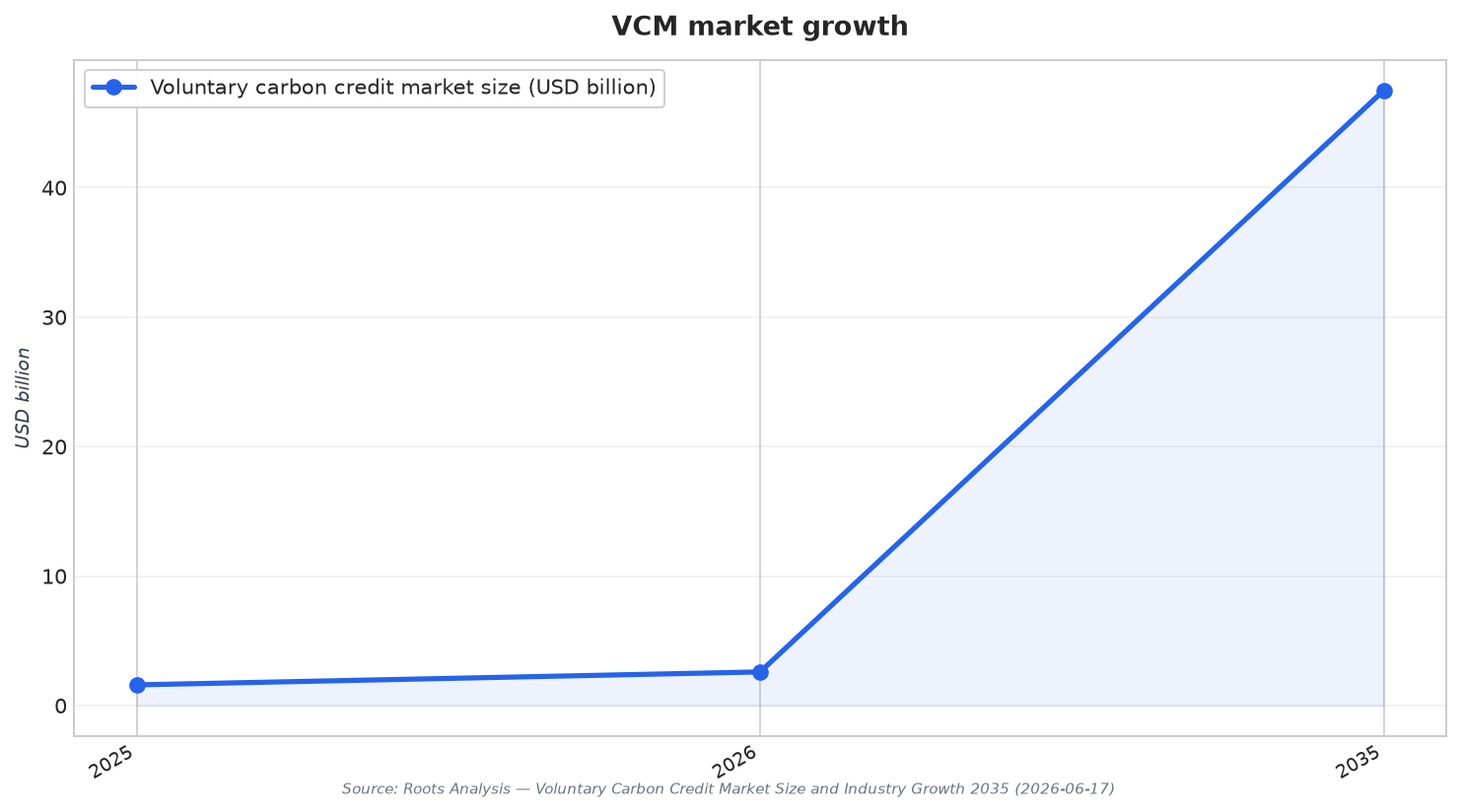
Supply potential is also becoming more concrete, especially where nature-based resources are strong. TNGlobal says Indonesia is strengthening its carbon market with a new regulatory framework and vast forestry resources, including peatlands and mangroves, and it has a pipeline of over 32 million tons of carbon credits, although growth remains dependent on international demand. The Carbon Trust highlights Southeast Asia’s foundations to become a major carbon trading hub and notes the region contains 40% of the global tropical peatland, underscoring why high-integrity nature projects matter. In wider context, Roots Analysis projects the voluntary carbon credit market will grow from USD 1.6 billion in 2025 to USD 2.6 billion in 2026 and USD 47.5 billion by 2035, at a CAGR of 38%.
What is driving traction in the ASEAN voluntary carbon market in 2026?
What is the ASEAN Common Carbon Framework (ACCF) expected to deliver?
Which ASEAN countries have voluntary carbon markets today?
What policy moves could boost Malaysia’s carbon trading activity?
How big is Indonesia’s current carbon credit pipeline?