
Indonesia’s two-wheeler economy is massive and highly concentrated, which makes any shift to electric meaningful even when volumes are still small. The wider two-wheeler market reached 6.41 million units in 2025 and is projected to reach 8.99 million units by 2030, expanding at a 7.07% CAGR for 2026–2030. Scooters represented 86.3% of 2025 volume, and the installed base exceeded 120 million motorcycles across a population of about 280 million. Unit sales are dominated by Honda and Yamaha, which together command roughly 96% of sales. Electrification, however, remained early: electric models were under 1% of 2025 volume, underscoring how much the transition still depends on affordability and policy durability.
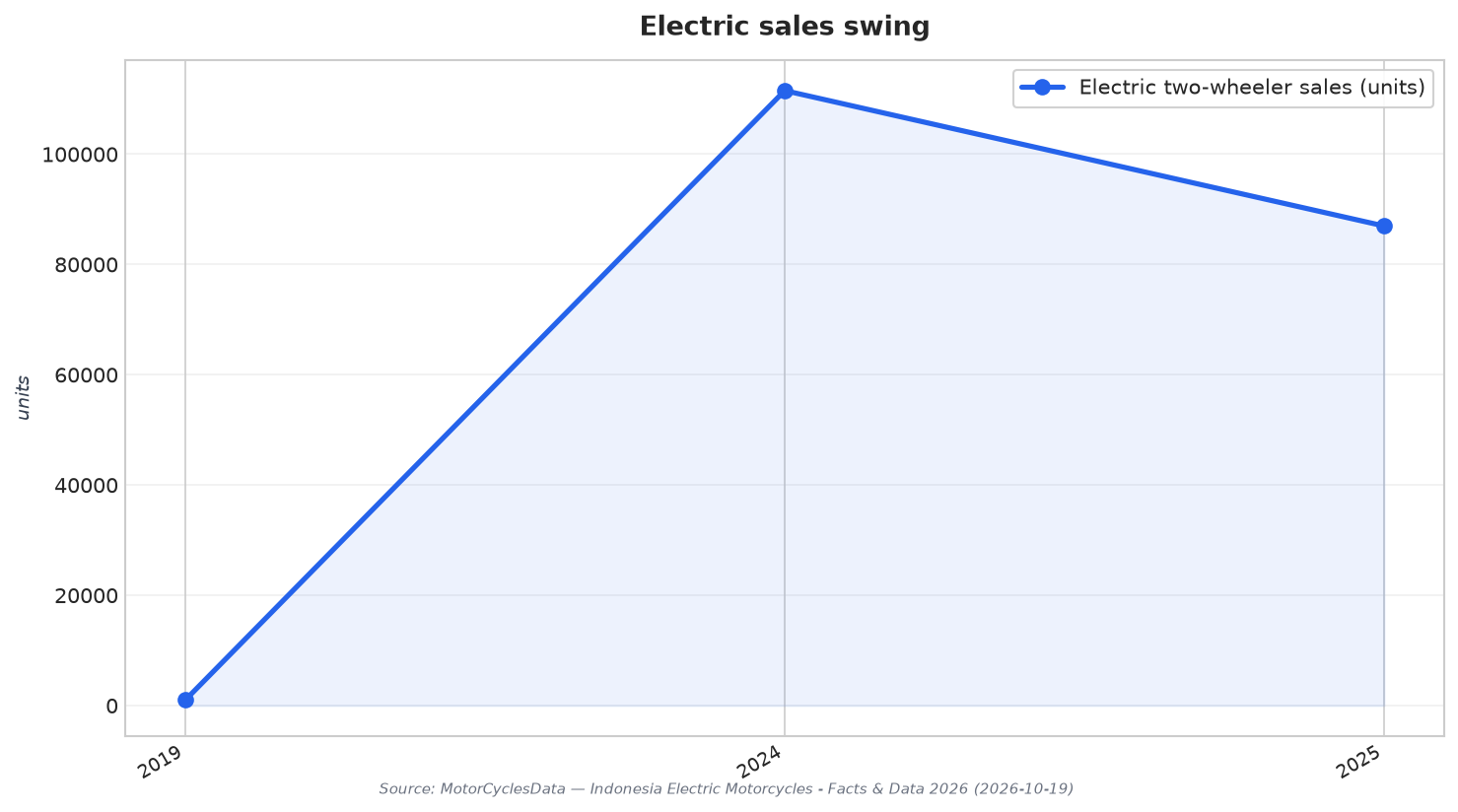
Measured purely by how far the sector has come from a tiny baseline, the electric story is striking. Electric two-wheeler sales increased from 1,043 units in 2019 to 111,535 units in 2024, an expansion of more than one hundred times in five years. That trajectory broke in 2025, when electric sales declined by 22.0% to 86,987 units, following the withdrawal of incentives that had supported 2024 growth. Another dataset estimates 2025 electric volume at 55,059 units, with electric two-wheelers accounting for 0.86% of Indonesian motorcycle sales that year. Together, these figures show both acceleration from a small base and the fragility of demand once incentives or expectations change.
Subsidies, Delays, and the Cost of Waiting
In 2026, the market’s biggest headwind has been uncertainty rather than technology. One tracking source reported electric two-wheeler sales of 40,062 units year-to-date July 2026, down 2.7% year on year, even as the overall motorcycle industry increased marginally. Another report describes growth of just 6.4% year-on-year through September 2026, after the government withdrew incentives and later introduced a new subsidy scheme worth IDR 3 million per vehicle. Separately, a May 2026 announcement described a stimulus subsidising 100,000 electric motorcycles at about IDR 5 million each, but implementation shifted from early June to July and then to August, and was still unresolved as of early September. Buyers reportedly asked about the subsidy and left without purchasing, illustrating how announced discounts can freeze real transactions.
Forecasts highlight the stakes of policy follow-through, and why the Indonesia electric motorcycle market is discussed as both a growth story and a stop-start transition. One forecast values Indonesia’s electric two-wheeler market at USD 75.38 million in 2025, rising to USD 317.26 million by 2030 at a 33.30% CAGR, with volume rising from 55,059 to 260,000 units by 2030. That same analysis notes that volume fell 28.57% from 77,078 units in 2024 to 55,059 in 2025, and that first-half 2026 fell from 25,463 units in first-half 2025 to 18,487. It also flags how far actual sales have lagged ambition, citing a 2 million unit target set in 2022 for 2025 that was met at 55,059 units, roughly 3% of the goal.
Competitive dynamics are also changing as established brands and new entrants position for the long game. Polytron grew 19.4% in electric two-wheelers, while Honda rose 50.8% in the same ranking period, a potentially important signal given Honda’s scale and distribution. Yamaha contracted 8.4%, and TVS appeared as a new entrant, with one market note pointing to TVS Motor Company’s iQube all-electric scooter entry in June 2025, listed with a 115 km range and a 78 kmph top speed. In parallel, battery swapping is emerging as a pragmatic path to scale, backed by the Gojek-linked Electrum ecosystem. Across these shifts, the core adoption challenge remains consumer economics: conventional scooters are familiar and supported by extensive fueling and service networks, so electric options must compete on purchase price, financing, and convenience.
How big is Indonesia’s overall two-wheeler market today?
What happened to electric motorcycle sales in 2025?
Why has the 2026 electric two-wheeler recovery looked weak?
What subsidy levels are being discussed for electric motorcycles in Indonesia?
What is the outlook for the Indonesia electric motorcycle market through 2030 in one forecast?