Carbon markets are becoming a more established part of climate policy, and Southeast Asia is moving with that current. The World Bank’s State and Trends of Carbon Pricing 2025 reports that carbon pricing instruments cover nearly 28% of global emissions, with 80 mechanisms in operation and more than US$100 billion mobilized for public budgets in 2024. In this landscape, ASEAN’s opportunity is not only about growing supply. It is about building a market that buyers trust, especially as carbon credits function as “credence goods” whose value depends on whether emissions reductions can be trusted.
On the supply side, Asia has already been prolific. By the end of 2024, Asia had cumulatively issued 2.978 billion carbon credits, representing 56% of the global total, according to the Asia Carbon Credit Market Development Report 2024; Southeast Asia contributed a significant and growing share of those credits. But global signals underline why credibility matters as much as volume. Ecosystem Marketplace’s 2025 State of the Voluntary Carbon Market found global voluntary market transaction volume fell 25% in 2024, and market value fell 29% to US$535 million. The lesson for ASEAN is clear: scaling supply without confidence can leave projects stranded.
The “Invisible Infrastructure” Buyers Will Scrutinize
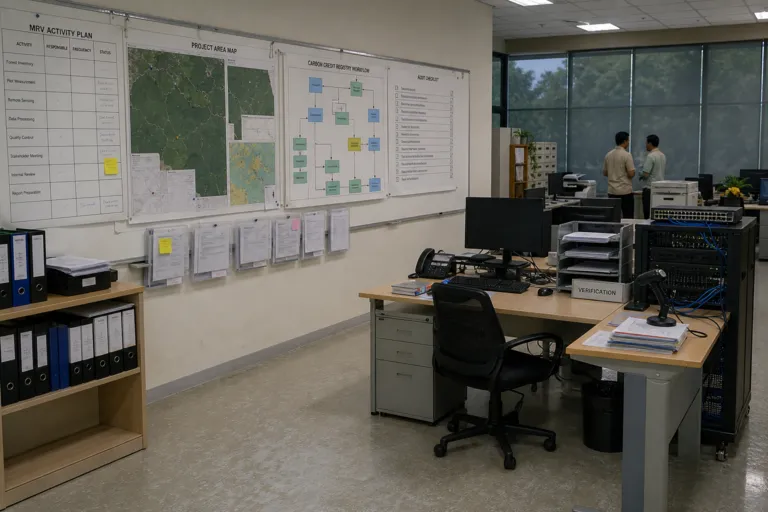
For ASEAN voluntary carbon markets to be durable, measurement, reporting, and verification (MRV) and credible tracking systems are foundational, not optional. ERIA argues MRV is the basis of market confidence, especially as the UNFCCC began developing digital registry infrastructure for Article 6 of the Paris Agreement in January 2026 to record, track, and verify international transfers. This pushes ASEAN toward data and registry standards that can connect to wider international markets without sacrificing integrity. It also responds to growing project activity: Climate Focus (2023), cited in the ASEAN Capital Markets Forum (ACMF) 2025 report, notes Southeast Asia and the developing Pacific had 284 carbon projects registered in the voluntary carbon market.
National and regional building blocks are emerging in parallel, though at uneven speeds. The Asian Banker reports that Indonesia, Vietnam, Malaysia, and Thailand are developing compliance carbon-pricing systems at different stages: Indonesia already operates an ETS, Vietnam is piloting one, Thailand is planning one, and Malaysia is studying a future ETS. Singapore has raised its carbon tax to SGD 45 per tonne in 2026 and signed Article 6 implementation agreements with ten countries, as part of its push to become a regional carbon-services and trading hub. Alongside these country paths, market associations from Malaysia, Indonesia, Singapore, and Thailand are developing the ASEAN Common Carbon Framework, aiming to align standards and principles for stronger integrity.
Sector credibility will also define whether carbon finance reaches where it is most needed. ISEAS reports Southeast Asia’s agri-food sector generated 55% of the region’s greenhouse gas emissions in 2022, equal to 1,627 million tonnes CO₂eq, and accounted for 10% of global agri-food emissions. Yet the agriculture sector has issued less than 1% of Southeast Asia’s carbon credits to date, despite an estimated US$100 billion annual financing gap that carbon markets could potentially help narrow. The paper outlines credit potential in peatland drainage prevention, rice methane mitigation, livestock enteric fermentation reduction, and agriculture nature-based solutions, while noting constraints such as costly monitoring, weak baseline data, and additionality challenges.
What is the biggest credibility challenge for ASEAN’s voluntary carbon market growth?
What recent global trend shows why trust matters in voluntary markets?
How far along are key Southeast Asian countries in compliance carbon pricing?
Why are ASEAN voluntary carbon markets paying more attention to registries and Article 6 links?
How can ASEAN’s agri-food sector connect to carbon finance despite low credit issuance today?