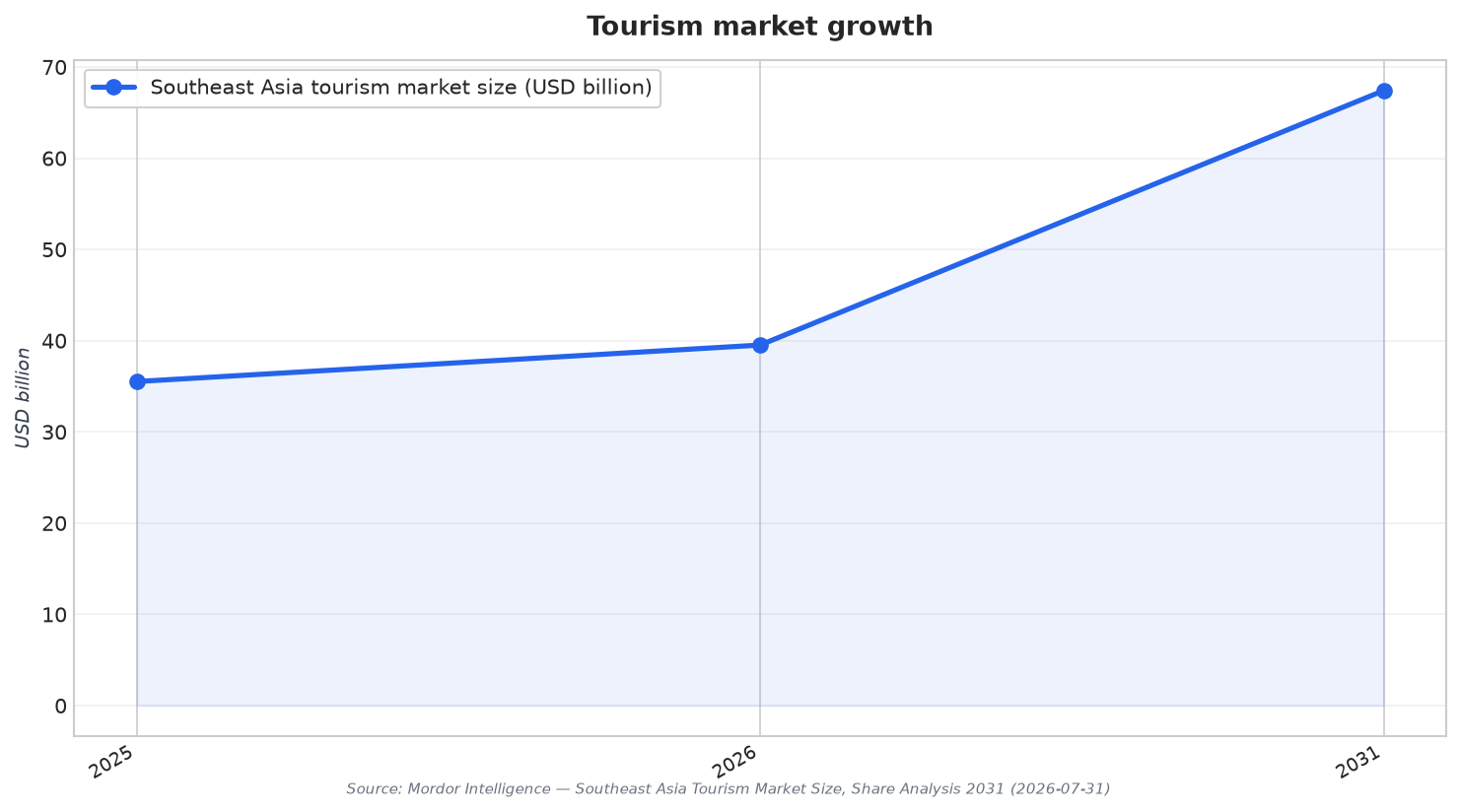
Corporate travel spend is rising again across Southeast Asia as the region’s broader travel economy accelerates. Mordor Intelligence expects the Southeast Asia tourism market to grow from USD 35.52 billion in 2025 to USD 39.52 billion in 2026, with a forecast of USD 67.41 billion by 2031. Within that recovery, corporate planners are reactivating in-person programs, and the MICE segment is described as “witnessing a resurgence,” with long-delayed events being finalized. The numbers underline the scale of the opportunity, but also the need for tighter travel management as more trips move from ad hoc travel into structured programs.
The recovery is not only about more trips. It is about who is traveling and how often. A 2026 corporate travel statistics roundup projects global corporate travel spending reaching USD 1.6 trillion, and places the global business travel market size at USD 1.48 trillion in 2024, described as recovering to 94% of pre-pandemic levels. It also reports average corporate travel spending of USD 1,248 per trip in 2023 and an average trip duration of 3.8 days globally. For travel managers in Southeast Asia, these global baselines provide context for budgeting and for evaluating how policy changes and supplier negotiations may perform as volumes build.
Why Southeast Asia’s MICE Rebound Is Pulling Spend Upward
MICE growth is one of the clearest signals behind the Southeast Asia business travel market 2026 discussion. Mordor’s regional breakdown shows leisure at 46.89% of the Southeast Asia tourism market size in 2025, while the MICE segment is advancing at a 13.92% CAGR to 2031. Domestic travel contributed 63.72% of market share in 2025, and international arrivals are forecast to grow at an 11.05% CAGR through 2031, a combination that can support both regional meetings and cross-border events. Thailand held 19.06% of the Southeast Asia tourism market share in 2025, while Vietnam is projected to log the fastest 13.22% CAGR through 2031, shaping where event and sales travel may concentrate.
Booking and expense behavior is also shifting toward mobile and automated tools, which changes how spend shows up and how compliance is enforced. The corporate travel statistics report cites a 55% adoption rate of mobile booking apps in corporations and notes that 68% of business travelers are frequent flyers logging 6+ trips per year. In Asia, it reports that business travelers average 4.2 international trips annually. At the Asia-Pacific level, Maximize Market Research values the Asia Pacific corporate travel market at USD 298.4 billion in 2025 and projects around USD 472.8 billion by 2032 at a 6.8% CAGR during 2026–2032, driven by recovery of business mobility, rising MICE activities, and digitalization of travel management systems.
Digital travel services are also taking a larger role in how spend is captured and optimized. Mordor notes that accommodation services held 58.15% of the Southeast Asia tourism market size in 2025, while travel services are set to expand at a 12.01% CAGR during the same period, supported by mobile-led search, booking, and review behaviors. Separately, Future Market Insights values the Asia-Pacific Tourism Spend Analytics & Forecast Market at USD 165.9 billion in 2026, growing at a 6.7% CAGR to reach USD 317.4 billion by 2036, and highlights AI-powered hyper-personalised travel commerce, including a statement that 63% of APAC travellers use autonomous re-booking tools. For corporate programs, these shifts point to faster changes in traveler expectations and the importance of data visibility across policy, booking, and spend.
What signals a rebound in corporate travel across Southeast Asia?
How fast is the MICE segment growing in Southeast Asia?
What does the Southeast Asia business travel market in 2026 connect to in the wider region?
What booking behavior changes are shaping corporate travel spend tracking?