As the United States expanded tariffs in 2025, trade did not simply shrink. It moved. Al Jazeera described the effect as supply chains being “rearranged,” not ended, as US customers kept buying and sourcing from different locations. The policy push was framed around reducing the US trade deficit, which the report said had swelled to about $918.4bn in 2024, or 3.1 percent of GDP, for goods and services. But the practical outcome in Asia was adjustment: if access becomes harder through one route, companies look for another. This is the backdrop for the ASEAN tariff diversification strategy 2026, where exporters build optionality across markets, production sites, and intermediaries while preserving competitiveness.
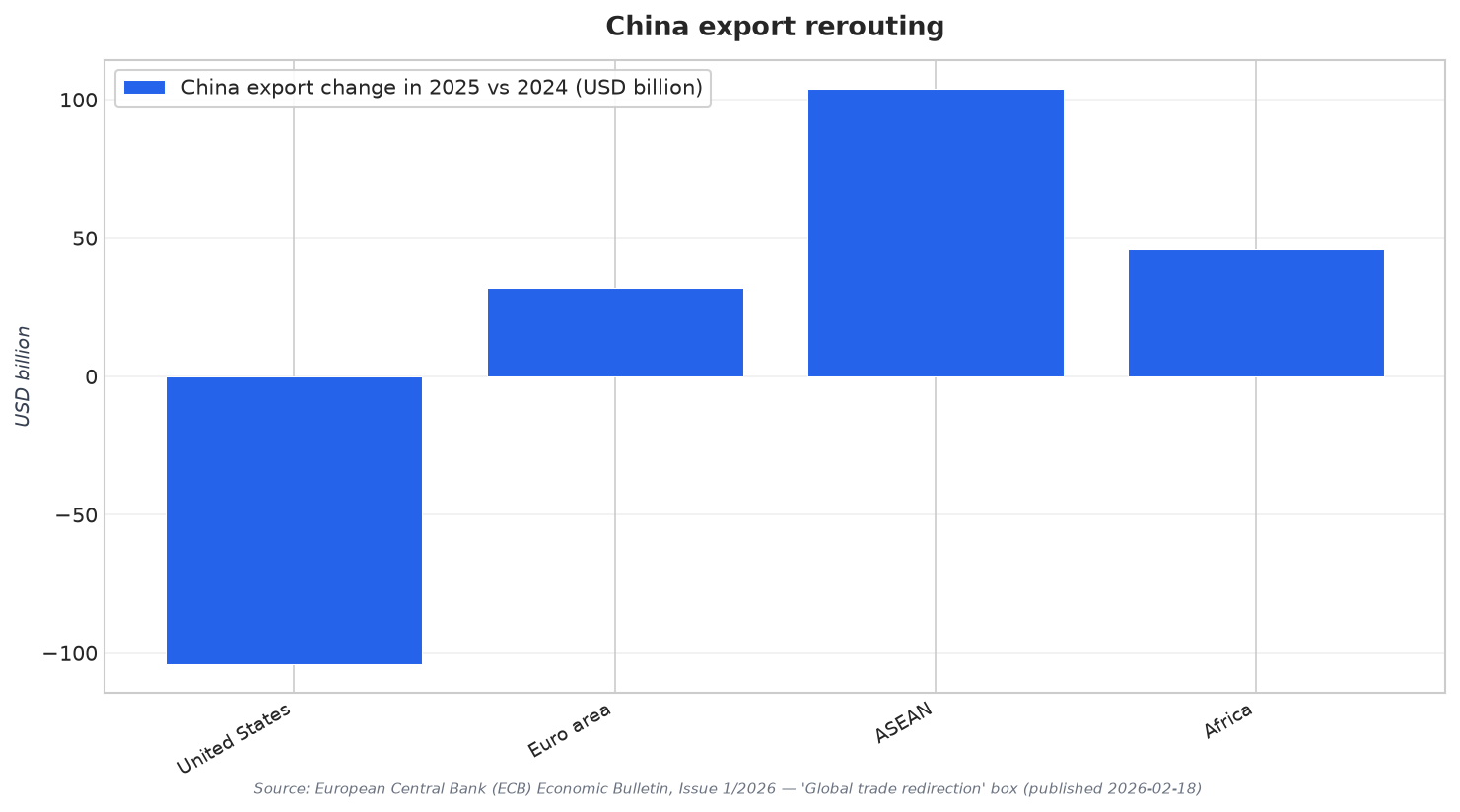
The biggest direct hit landed on China-bound flows into the US. The Peterson Institute for International Economics was cited by Al Jazeera as putting the average US duty on Chinese goods at 47.5 percent as of November 2025. In the same period, Chinese customs data showed the value of Chinese exports to the US fell 20 percent in 2025. US Census data, also cited by Al Jazeera, reported imported goods from China falling from $438.7bn in 2024 to $266.3bn in 2025, while the overall US trade deficit for goods fell from $245.5bn to $175.4bn. Yet the change created openings elsewhere. McKinsey reported that tariffs triggered trade readjustment, with US–China trade falling by around 30 percent and the United States replacing about two-thirds of the gap with imports from other sellers.
Rerouting Works Because ASEAN Sits in the Middle of Two Shifts
ASEAN’s role grew because two shifts happened at once: US buyers sourced more from the region, and Chinese exporters sought new destinations beyond the US. McKinsey estimated that from 2024 to 2025, the US import share from China fell about 4.4 percentage points, while shares rose for ASEAN by 2.5 percentage points and for the rest of Asia–Pacific by 2.4 percentage points. Asia Society added that between 2022 and 2025, ASEAN exports to the United States grew 37.5 percent, roughly five times the pace of exports to China, the EU, Korea, or intra-regional trade, while exports to Japan contracted. This is not only “rerouting,” as an IMF working paper cited by Asia Society found that exports from several ASEAN economies in affected product categories continued to outperform other exports through 2022–2023 and expanded beyond the US market.
At the same time, China’s exports were redirected across markets, including deeper penetration into ASEAN. The ECB reported China’s export value grew 5.5% in 2025, with exports to the United States declining 20% but export growth to ASEAN rising 13%, and to the euro area 8%, Latin America 7%, and Africa 26%. Asia Society highlighted how this shows up in consumer markets: Chinese vehicle exports to ASEAN rose 45% in 2025, led by electric vehicles, with export value nearly doubling to $8.2 billion as part of a clean-tech wave. For ASEAN exporters, this creates both opportunity and pressure: access to Chinese inputs can support competitiveness, but China’s export surge can also intensify competition in the same downstream markets ASEAN is targeting.
Some rerouting is enabled by capital and capacity embedded in Southeast Asia over years. Asia Times reported that Chinese entities committed approximately $60 to $65 billion in Indonesian nickel processing infrastructure between 2010 and 2024, turning Indonesia from a raw-material exporter into a vertically integrated processing hub. The same article said the US goods and services trade deficit with Vietnam reached $178.2 billion in 2025, up $54.7 billion from 2024, and noted that January 2026 exports to the US grew 33.9%, while electrical and electronic product exports surged 25.3% in December 2025 alone. Put together, the practical playbook is clear: diversify customer markets, strengthen intermediate processing, and maintain flexible sourcing so tariff shocks do not force a single-point failure.
What changed when the US raised tariffs in 2025?
How much did US imports from China fall in 2025?
What evidence shows ASEAN gained from supply chain shifts?
How are Chinese exports shifting toward ASEAN and other regions?
What does an ASEAN tariff diversification strategy for 2026 look like in practice?