Southeast Asia’s aquaculture base is large enough to shape export supply chains, even as markets push harder on standards. ASEAN-focused reporting shows aquaculture in Southeast Asia accounted for ~54% of total production volume and 47% of value in 2022, after a mixed five-year trend that included +0.9% in 2019, -1.3% in 2020, and +3.0% from 2021–2022 (SEAFDEC, 2025). That backdrop matters in 2026 because the global aquaculture market is forecast at US$ 332.4 billion in 2026, with Asia Pacific leading at 56% global share in 2026 in one outlook. Another forecast puts the global aquaculture market at USD 330.3 billion in 2026, expanding to USD 447.1 billion by 2033.
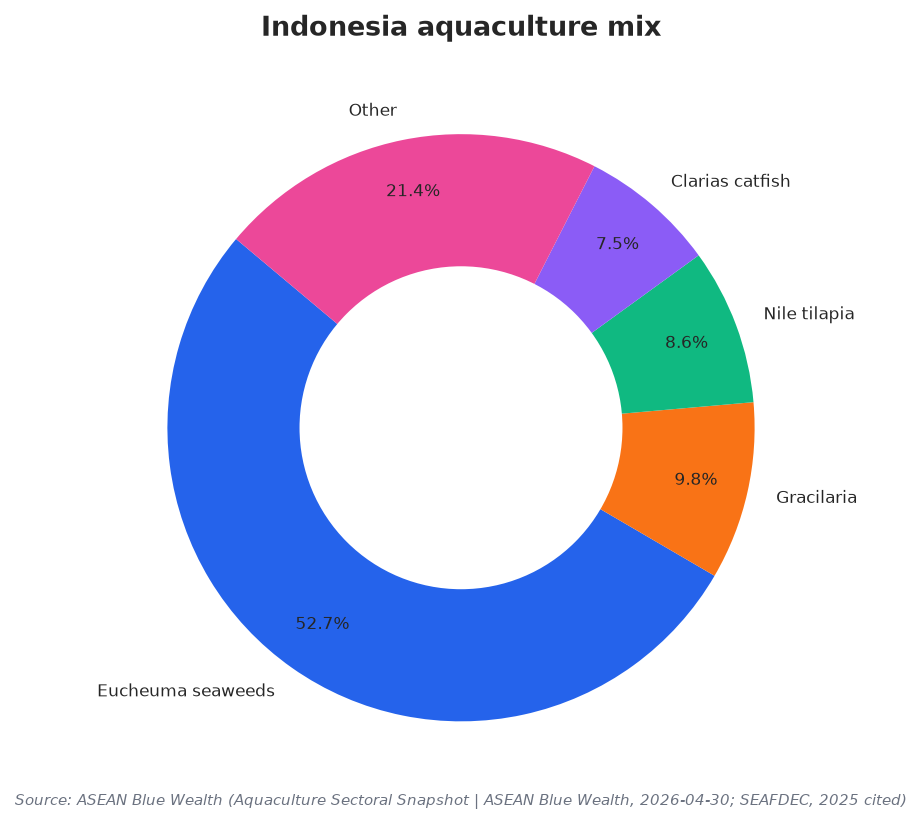
For exporters, the shrimp-and-seaweed pairing is practical, not symbolic. ASEAN analysis highlights that higher value brackish crustaceans (vannamei/monodon) could lift export revenues, while scaling seaweeds and freshwater staples supports volume and affordability. The same snapshot shows how production profiles reinforce that logic by country. Indonesia led output, driven by Eucheuma seaweeds (52.7% of volume; 18% of aquaculture value) alongside Gracilaria (9.8%), Nile tilapia (8.6%), and Clarias catfish (7.5%). Viet Nam ranked second with striped catfish (33%), freshwater fishes (16.6%), whiteleg shrimp (15.5%), and cyprinids (9.8%). The Philippines was third, dominated by Kappaphycus (62.8%) and milkfish (16.5%).
Shrimp Value, Seaweed Volume, and the 2026 Rules Push
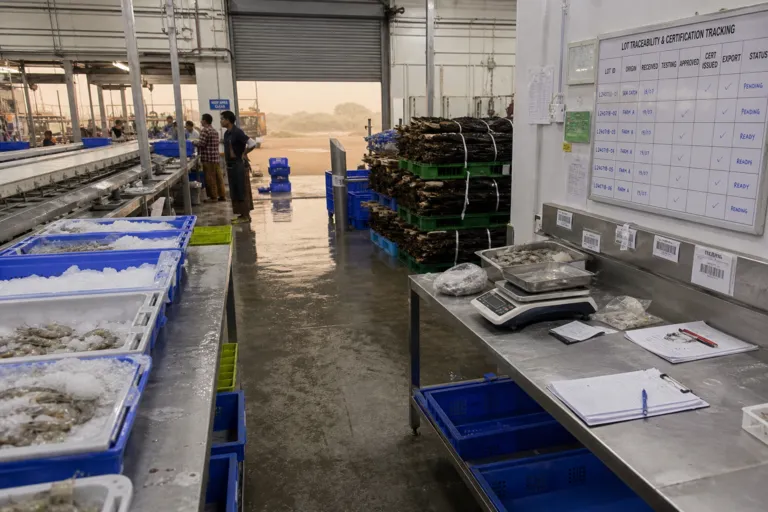
In 2026, market signals point to shrimp as a premium-facing growth lane, while seaweed remains a scale anchor in parts of maritime Southeast Asia. One aquaculture market outlook frames crustacean farming, particularly biosecure whiteleg shrimp, as the highest-value growth opportunity through 2033, aimed at premium-certified export channels in Europe and North America. At the same time, ASEAN guidance emphasizes embedding digital traceability and certification across value chains, supported by blended finance, in line with EU 2026 rules and the US Seafood Import Monitoring Program (SIMP). This is positioned as a pathway to leverage Aquaculture Stewardship Council (ASC) programs and access instruments such as Asian Development Bank (ADB) blue loans and MSME financing facilities including the Development Bank of the Philippines (DBP)–Agricultural Credit Policy Council (ACPC) program and Indonesia’s Kredit Usaha Rakyat (KUR) scheme.
Regional producers also operate inside broader category economics that can affect export competitiveness and investment decisions. In one global segmentation view, crustaceans represented 24.8% in 2025 and were described as growing fastest at approximately 4.60% CAGR, while brackish water aquaculture accounted for 20.1% in 2025 and was linked to coastal shrimp pond farming across Southeast Asia and India. For seaweed, a separate global market segmentation explicitly tracks “brown seaweeds” as a fish-type category, showing aquatic plants are no longer treated as niche in market reporting. For a concrete non-ASEAN comparison on export momentum, Ecuador’s shrimp exports reached 125,215 metric tons in January 2026, up 23% year-on-year.
The export engine runs on operational readiness, and the region’s constraints are well documented alongside its potential. ASEAN reporting flags reliance on wild seed in some areas, gaps in hatchery and sanitary capacity, and vulnerability to disease outbreaks and water-quality pressures, while also noting uneven regulation and fragmented governance that can limit resilience and scaling. Yet company and market updates suggest demand remains durable for processed export formats. In August 2026, Thai Union Group reported frozen sales held broadly stable at THB 10.0 billion in the second quarter of 2026, led by frozen shrimp, and its frozen gross profit margin improved to 13.5%. For 2026 planning, Southeast Asia shrimp aquaculture sits at the intersection of premium compliance, stable processing demand, and the region’s seaweed-driven production depth in key coastal economies.
What share of Southeast Asia’s aquaculture did the region account for in 2022?
Which country profiles show seaweed leading aquaculture volumes in ASEAN data?
How is shrimp positioned for export value in 2026 and beyond?
What trade-compliance tools are emphasized for Southeast Asia shrimp aquaculture in 2026?
What is one 2026 indicator of processed shrimp demand from a major regional company?